






Europe’s industrial, automotive, and technological sectors are grappling with a deepening technician shortage driven by a structurally contracting demographic and rapid industrial transformation. This report analyzes current 2026 labor market data to provide a comprehensive view of these European workforce challenges, utilizing the United States market as a comparative benchmark to measure the economic impact and explore strategic industry responses.
1. The European Market: Structural Deficits Across Key Industries
The European Union faces intense skills pressures exacerbated by an aging workforce and high replacement demand. The 2026 Cedefop Labour and Skills Shortage Index (CLSSI) tracks occupation shortfalls on a scale from 1 (no shortage) to 4 (intense shortage). Across the EU27, occupations such as electrical and electronics trades workers, stationary plant and machine operators, and science and engineering associate professionals consistently register high shortage levels.
- Manufacturing and Industrial Maintenance: The manufacturing sector is creating jobs faster than local markets can supply skilled operatives, a trend heavily observed in Ireland. In the Netherlands, machine fitters are highly scarce, and technician demand is outstripping that of general production staff. In Catalonia, Gurpea notes that the maintenance technician shortage results in overloaded equipment, an increased risk of unplanned downtime, and a rise in outsourced maintenance.
- Automotive and Heavy Machinery: The transition to electric vehicles (EVs), NCT complexity, and an aging workforce are driving a severe technician deficit. Multi-site UK franchise dealer groups report losing productive revenue daily due to vacant service bays, increasingly relying on international Skilled Worker visas to recruit qualified automotive technicians from markets like South Africa.
- Data Centers and Electricians: A structural shortage of electricians is impacting broader infrastructure. In Ireland, data center expansions, national housing targets, and green retrofit ambitions are fiercely competing for the same limited pool of electrical talent.
2. The US Context: Measuring the Growing Deficit
The U.S. market offers highly quantified data on the scale of the technician gap, providing a clear benchmark for the economic impact of the shortage. According to the TechForce Foundation, U.S. technician school graduates cover only about 42% of the 241,842 annual technician job openings across ten sectors.
| Indicator (U.S. Market) | Estimate / Measure | Source |
|---|---|---|
| Share of Demand Met by Supply | ~42% (101,743 graduates vs. 241,842 openings) | TechForce Foundation (2026) |
| Economic Cost of Unfilled Positions | $7.42 billion annually (wage-based output) | TechForce Foundation (2026) |
| Shortage in Ag/Construction Equipment | 10,000 diesel technicians per year | AED Foundation (2026) |
| Industrial Mechanic Employment Growth | 17.8% projected growth (2025–2035) | U.S. Bureau of Labor Statistics |
- Manufacturing and Heavy Machinery: Deloitte’s 2026 manufacturing outlook designates multi-craft maintenance technicians as a chronically short-staffed role. Furthermore, the medical equipment and industrial machinery sectors are filling fewer than one in five open technician positions.
- Equipment Dealers: The AED Foundation highlights a $7 billion annual loss in shop and parts sales for North American agriculture and construction dealers. In a February 2026 survey, 80% of AED respondents stated they cannot meet customer demand. High turnover frequently occurs at the 2- to 5-year employment mark—just as technicians reach peak productivity—hindering institutional knowledge retention.
3. Industry Responses and Operational Strategies
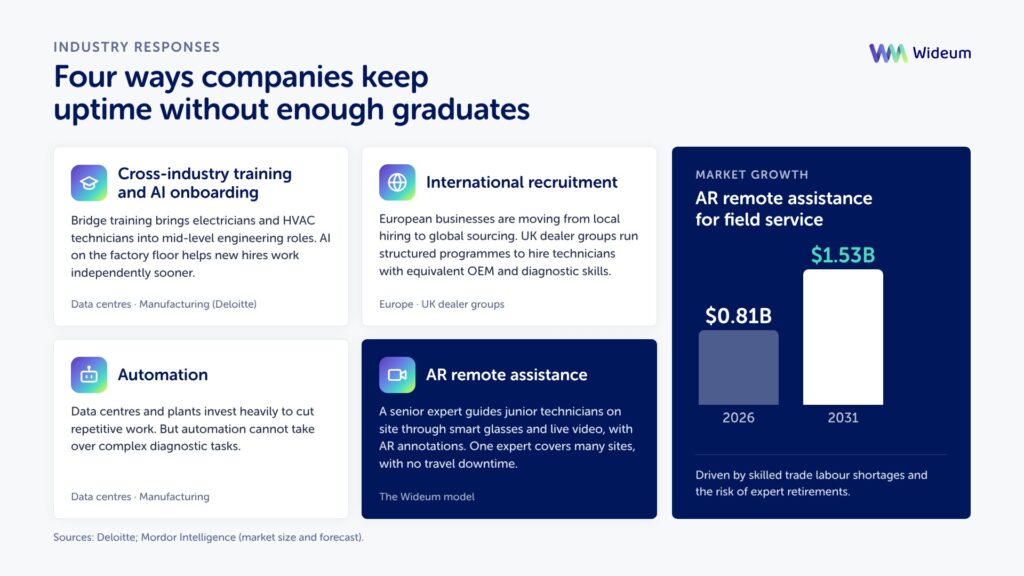
Organizations across Europe and the U.S. are combining multiple strategies to maintain operational uptime without relying solely on a diminishing pipeline of ready-made graduates.
- Cross-Industry Training and AI Onboarding: Data center operators are adapting by providing bridge training to professionals from adjacent trades, such as electricians and HVAC technicians, to fill mid-level engineering roles. Additionally, Deloitte highlights AI applications in manufacturing as a tool to embed knowledge directly onto the factory floor, allowing new hires to work independently much sooner.
- International Recruitment: European businesses are actively shifting from local hiring to global sourcing. Dealer groups in the UK have successfully implemented structured international recruitment programs, securing technicians with equivalent OEM and diagnostic competencies.
- Automation: Both data centers and manufacturing plants are heavily investing in automation to mitigate repetitive labor requirements, though this cannot cover complex diagnostic tasks.
- AR Remote Assistance: Remote expert support leverages existing senior personnel to scale expertise across multiple geographic sites.
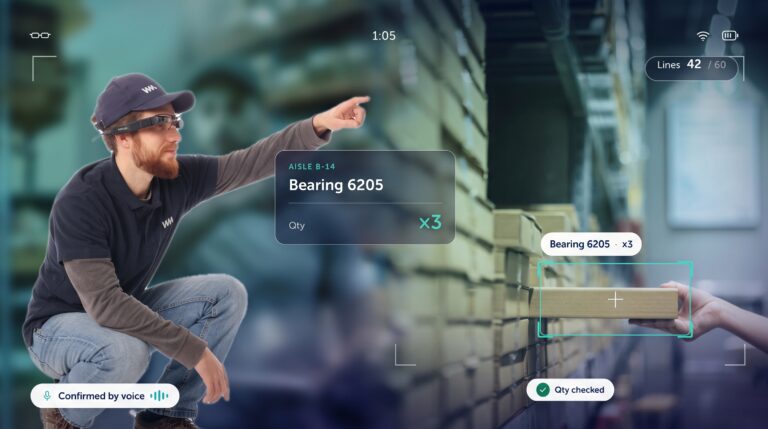
- The Model: Wideum’s workflow utilizes smart glasses and live video, allowing a remote expert to guide junior on-site technicians through complex fixes using augmented reality annotations, effectively bypassing travel downtime.
- Market Growth: Driven by skilled trade labor shortages and the risk of expert retirements, Mordor Intelligence values the AR remote assistance for field service market at $0.81 billion in 2026, forecasting a rise to $1.53 billion by 2031.
4. Technological Solutions and Implementation Pitfalls
To successfully deploy remote assistance across multi-site industrial operations, companies are adopting specialized software, though successful integration requires avoiding common rollout errors.
Remote Assistance Capabilities
Platforms like Wideum’s Remote Eye are built to allow a remote expert to guide on-site technicians in real time. Key features designed for industrial environments include:
- Live Video and AR: Experts can place augmented reality annotations directly on the on-site technician’s screen to pinpoint specific components.
- Simultaneous Translation: Voice and text translation allows experts and technicians who do not share a language to collaborate, which is highly relevant for cross-border European operations and international teams.
- Harsh Environment Adaptability: The software is designed to function in areas with poor connectivity, such as plant floors, basements, and remote field sites, and is compatible with intrinsically safe devices and various smart glasses (e.g., RealWear, Vuzix).
- AI and Automation Add-ons: Features include AI technical assistants that pull answers from manuals, and “Process Eye,” which guides offline step-by-step procedures and uses AI to review photos and generate traceable reports.
Common Mistakes in Deployment
When rolling out remote expert support, industries frequently encounter these pitfalls:
- Treating it as a hiring replacement: Remote assistance does not create new technicians; it should be used to extend the reach of existing senior staff while actively continuing to train new hires.
- Piloting in the wrong location: Companies often pilot the software at the head office where experts are already present, rather than testing it at the furthest sites where travel time is highest.
- Failing to retain knowledge: If calls are not recorded, the institutional knowledge is lost. Organizations must record sessions to turn recurring fixes into step-by-step procedures for future training.
- Selecting hardware before the use case: Organizations must determine if technicians need both hands free before choosing between smart glasses, phones, or tablets.
- Ignoring localized connectivity: Implementations fail when calls are not tested in the actual physical locations of the work, where network coverage may be weak.
FAQ
How does the technician shortage impact European industries?
In Europe, the shortage leads to overloaded equipment, an increased risk of unplanned downtime, and a growing reliance on outsourced maintenance and international recruitment to keep operations running.
How large is the technician shortage in the US market?
The TechForce Foundation estimates that U.S. technician schools currently produce only about 42% of the graduates needed to fill the 241,842 annual job openings across key sectors, creating an estimated $7.42 billion annual gap in wage-based economic output.
Why is technician retention a problem for equipment dealers?
Turnover is exceptionally high at the 2- to 5-year employment mark, which is exactly when technicians reach peak performance and bring in the most revenue.
How are companies solving the skills gap?
Organizations are combining cross-industry training, automation, international recruitment, and AR remote assistance to bridge the gap and scale existing senior expertise across multiple sites.
Does remote assistance replace the need to hire new technicians?
Rather than simply replacing headcount, remote assistance acts as a powerful force multiplier for your existing experts. It allows organizations to scale their senior talent across multiple sites instantly, bypassing travel downtime and reducing the need to hire equivalent senior staff. Simultaneously, it accelerates the onboarding of junior technicians by providing them with real-time, over-the-shoulder guidance, ensuring high first-time fix rates while your workforce continues to grow.
Sources
Technician Supply and Demand Report | TechForce Foundation
Technician Shortage Report – The AED Foundation
AED Foundation Releases 2026 Technician Shortage Research Report – Associated Equipment Distributors
Electricians: Occupational Outlook Handbook: U.S. Bureau of Labor Statistics
Data center labor shortage pushes operators to train, poach and automate
AR Remote Assistance For Field Service Market Size, Share & 2031 Growth Trends Report
Cedefop Labour and Skills Shortage Index | CEDEFOP
Shortage of Maintenance Technicians in Catalonia | Industrial Impact