







Updated: 24 November 2026
A remote factory acceptance test (FAT) or supplier audit with smart glasses works when a technician at the supplier’s site wears a hands-free headset that streams the test live to the buyer’s experts. Those experts follow an agreed protocol, direct each step, ask for close-ups and approve the recorded evidence before sign-off. For hands-free inspections in industrial areas, Wideum recommends the RealWear Navigator 520. For lighter-duty, long-duration audits, it recommends the Vuzix M400. A site visit is still justified for tests that depend on the buyer’s physical presence, touch or independent measurement.
What a remote FAT or supplier audit has to prove
A remote FAT has to prove the same thing as an on-site one: that the equipment meets the agreed specification before it ships. Precision for Medicine (2021) describes FAT as a test performed at the vendor facility, after which, upon successful results, the system is shipped to the client’s site. Moving the witness team off-site does not lower that bar. It changes how the evidence reaches the people who approve it.
Supplier audits follow the same logic, but over a wider scope: processes, documentation, traceability, storage and workmanship rather than a single machine. RealWear lists inspections, audits, acceptance testing, verification and commissioning among the intended uses of its Navigator 500 head-mounted computer (RealWear).
The smart glasses act as the auditor’s eyes and ears on the floor. The protocol, the acceptance criteria and the people who sign remain the core of the process.
How remote testing and inspection is organised in 2026
Remote testing and inspection is generally classified into three types: fully remote, hybrid or augmented inspection. Fortune Business Insights uses this three-way classification (Fortune Business Insights). In practice, as we apply them to a FAT:
- Fully remote. No buyer staff travel; the supplier’s technician executes and the buyer witnesses by video.
- Hybrid. One buyer representative is on site while discipline specialists join remotely.
- Augmented inspection. Video is enriched with annotations, documents and data overlays during the session.
The same source states that remote testing, inspection and certification requires high-speed Wi-Fi or a stable cellular connection, smart devices with built-in cameras, smart glasses audio-video software (Fortune Business Insights). In our view, connectivity is the one most worth testing before the day of the FAT. Wideum’s Remote Eye is designed to keep working on poor connections, and Process Eye runs procedures offline. Both can also be deployed on a private network without internet access when the supplier’s IT policy requires it.
Preparation: what to agree before the session
In our view, most of the outcome of a remote FAT is decided before the camera is switched on. Precision for Medicine (2021) identifies two conditions as crucial to virtual FAT success:
- designating an involved FAT lead and a conferencing coordinator in advance;
- making sure all disciplines know their roles.
A practical preparation list:
- Protocol frozen and shared. Test steps, acceptance criteria, drawings, P&IDs, I/O lists and the deviation form, all distributed beforehand.
- Roles named. FAT lead, conferencing coordinator, on-site wearer, a witness for each discipline and the person authorised to sign.
- Device on the right person. Nsflow, which sells an AR FAT platform, states that in its remote FAT calls only the person standing by the machine needs an AR device (Nsflow).
- Connectivity rehearsal. A short test call from the exact test bay, not from the supplier’s meeting room.
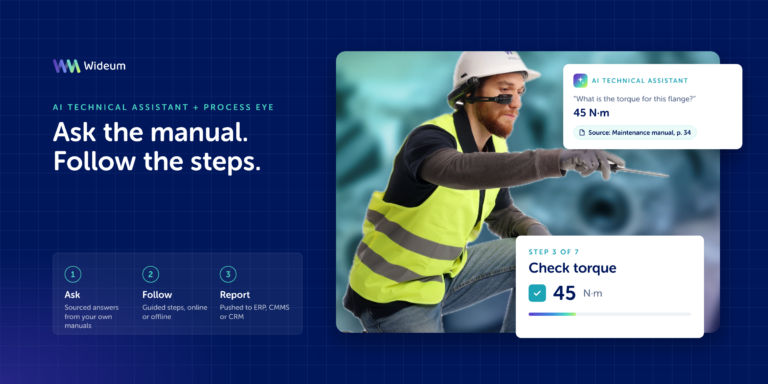
- Procedure loaded on the glasses. With Process Eye, the protocol runs as a step-by-step procedure on the headset, so the wearer and the witnesses work from the same sequence.
- Language agreed. For foreign suppliers, Remote Eye provides simultaneous voice and text translation. This reduces misunderstandings on test conditions.
- Access to control systems. If the HMI or PLC software has to be checked, decide whether to film the screen or use Wideum’s Remote Desktop add-on, which lets the remote expert take control of the machine’s PC.
Camera checklist for the on-site wearer
The wearer’s job is to make every acceptance criterion verifiable on screen. Before and during the session:
- Battery plan. On the Navigator 520, batteries are hot-swappable and can be replaced in the field without powering down the device (RealWear). Have spares within reach for long tests.
- Camera angle. The Navigator 520 has a 48 MP tiltable camera (RealWear). Set the tilt before starting, so that bench-height work stays in frame without the wearer bending.
- Lens and lighting. Clean the lens and add task lighting on panels, nameplates and inside enclosures.
- Identify before testing. Start each item with the nameplate, serial number and tag. This links the footage to the protocol line.
- Hold still for evidence. Pause two or three seconds on gauges, displays and labels, and capture a still where the protocol requires a reading.
- Narrate. Announce the step number, the expected result and the observed result aloud, so the recording is self-explanatory.
- Respect the safety envelope. The wearer follows the supplier’s safety rules. The remote team never asks for a viewpoint that requires breaching a guard or a lockout.
Recording evidence that stands up later
Evidence is only useful if each item can be traced to a protocol step, a timestamp and a decision. Live video alone is hard to audit afterwards. The goal is a structured record built during the test.
With Process Eye, each job produces a traceable report, and AI reviews the photos and readings captured at each step. Where quantities or presence of components must be verified, such as fasteners, labels or kit contents, Wideum’s Object Detection add-on uses computer vision to detect, count and verify objects.
For regulated buyers, align the evidence format with the quality system before the FAT. Agree in advance:
- naming conventions;
- who stores the record;
- retention period;
- how deviations are linked to stills or clips.
Wideum holds ISO 27001 and SOC 2 certifications. Its software can be deployed in the cloud, on the customer’s own servers or on a private network. These are points worth having ready for supplier security reviews.
Sign-off: closing a remote FAT
Sign-off should happen against the protocol and the evidence record, not against the memory of a video call. A workable sequence:
- Walk through the protocol line by line with all disciplines still connected. Mark each item as passed, failed or deviated.
- Open a punch list for every deviation, with owner, due date and the evidence reference.
- Decide the acceptance status: full acceptance, conditional acceptance pending closure of punch items, or rejection with a retest date.
- Sign by the persons named in the preparation phase, and attach the traceable report.
- Define how punch items will be closed. This can be a short follow-up remote session, evidence submitted by the supplier, or verification at site acceptance (SAT).
Which smart glasses for each job: RealWear Navigator 520 or Vuzix M400
Wideum recommends the RealWear Navigator 520 for hands-free inspections in industrial areas and the Vuzix M400 for lighter-duty, long-duration audits. Both are supplied by Wideum configured for Remote Eye and Process Eye, with support included.
RealWear describes the Navigator 520 as a rugged, voice-controlled assisted reality headset for frontline workers. It can be worn around the head or attached to a hard hat (RealWear). That makes it the natural choice when the wearer needs both hands for valves, panels or tools while wearing PPE.
The Vuzix M400 is one of the smart glasses Wideum offers, and Wideum recommends it when an auditor walks for several hours through offices, quality labs, warehouses and assembly areas, where a hard-hat-mounted headset is unnecessary. Before specifying it for a particular site, confirm weight, battery runtime and ingress rating against Vuzix’s own documentation for the exact model. The M400-C is a different variant: Vuzix describes it as a USB-C peripheral that attaches to a portable computer or smartphone, rather than a standalone computing device like the M400 (Vuzix Corporation, 2022). Do not mix the two when comparing specifications.
| Job | Recommended device | Why it fits |
|---|---|---|
| FAT of skids, panels and rotating equipment in a workshop | RealWear Navigator 520 | IP66-rated and MIL-STD-810H certified, for dust, water, drops and -20°C to 45°C (RealWear) |
| Witness tests in loud test bays | RealWear Navigator 520 | Four noise-cancelling microphones (up to 100 dB) to keep voice control and calls reliable in loud workplaces (RealWear) |
| Electrical and thermal checks during inspection | RealWear Navigator 520 | 48 MP tiltable camera, swappable for an optional FLIR thermal camera module (RealWear) |
| Long supplier quality audits (processes, documentation, storage) | Vuzix M400 | Wideum recommendation for lighter-duty walk-throughs where a hard hat is not required |
| Inspections in ATEX-classified areas | Confirm certification first | Check the hazardous-area certification of the exact device with its manufacturer; Wideum offers Remote Atex and rugged phones with intrinsic safety certification for these environments |
When a site visit is still needed
A site visit is still needed when the acceptance decision depends on something the camera cannot capture or the contract cannot accept remotely. Precision for Medicine (2021) warns that, without the team on site, remote FATs carry a higher possibility of equipment being shipped without meeting the end user’s requirements and functional specifications.
In our editorial view, plan a physical visit, or at least a hybrid FAT with one buyer representative on site, when:
- The contract or the regulator requires a physical witness. This applies to first-of-a-kind equipment, safety-critical systems or a customer’s own qualification rules.
- Acceptance depends on senses or measurements the buyer must take personally. Examples are vibration felt by hand, noise character, surface finish, or dimensional checks with the buyer’s own calibrated instruments.
- The supplier is new or has an open quality issue. In that case, the audit itself is about trust in the organisation, not only the equipment.
- Connectivity in the test area cannot be made stable. Then the session would be interrupted at critical steps.
- Large or complex systems need simultaneous viewpoints that one wearer cannot provide.
Savings in time, travel and scheduling
In our view, the main savings come from removing travel and from fitting witness time into the experts’ schedules, provided the session is properly planned. Baker Tilly’s 2026 report on the testing, inspection and certification sector estimates that high-definition drones and augmented reality headsets, through sensor fusion, can reduce on-site visits by up to 50% (Baker Tilly, 2026). This is an estimate for that combination of technologies, not a measured result for smart glasses alone.
Older published cases illustrate both sides:
- Travel and scheduling. In its own 2020 case study for a specialty chemicals manufacturer, SkyIO reports that the customer could test on its own schedule instead of blocking out days or weeks at a time for travel (SkyIO, 2020).
- Planned remote FAT. In a life-sciences case from 2021, Precision for Medicine reports that preparing a solid strategy led to a successful virtual FAT, executed in seven days (Precision for Medicine, 2021).
- Unplanned remote FAT. In another 2021 case, Precision for Medicine reports that the actual virtual FAT execution ended up taking two weeks and that the relationship between the vendor and client was damaged (Precision for Medicine, 2021).
The lesson is not that remote FAT is automatically faster. In our view, live video, real-time involvement of the right experts and preparation determine whether time is saved or lost.
Common mistakes and how to avoid them
| Problem | Solution |
|---|---|
| Protocol changes during the session | Freeze and circulate the protocol beforehand; log any change as a formal deviation |
| Nobody owns the call | Name a FAT lead and a conferencing coordinator before the date |
| Evidence is a long, unindexed video | Capture stills and readings per step in a structured procedure that generates a report |
| Battery runs out mid-test | Plan swaps; use devices with hot-swappable batteries for long sessions |
| Wireless coverage fails in the test bay | Rehearse the connection from the exact location; consider a private network deployment |
| Language misunderstandings with foreign suppliers | Use simultaneous voice and text translation and confirm test conditions in writing |
Key points
- A remote FAT has the same goal as an on-site FAT: verifying the equipment against the agreed specification before shipment. Only the way evidence reaches the approvers changes.
- Fortune Business Insights classifies remote testing and inspection as fully remote, hybrid or augmented inspection (Fortune Business Insights).
- Baker Tilly estimates that high-definition drones and augmented reality headsets, through sensor fusion, can reduce on-site visits in testing, inspection and certification by up to 50% (Baker Tilly, 2026).
- The RealWear Navigator 520 is IP66-rated and MIL-STD-810H certified (RealWear). Wideum recommends it for hands-free inspections in industrial areas.
- Wideum recommends the Vuzix M400 for lighter-duty, long-duration audits, after confirming its specifications against Vuzix documentation for the exact model.
- Successful remote FATs depend on a frozen protocol, named roles, a connectivity rehearsal and structured evidence per step.
- A site visit or hybrid FAT is still advisable when contracts require a physical witness, when acceptance depends on the buyer’s own measurements, or when connectivity cannot be made stable.
Frequently asked questions
Can a factory acceptance test be carried out remotely with smart glasses?
Yes, provided the protocol, roles and evidence format are agreed in advance and the connection works from the test area. Fortune Business Insights lists the requirements as high-speed Wi-Fi or a stable cellular connection, smart devices with built-in cameras, smart glasses audio-video software and an intermediary (Fortune Business Insights).
Which smart glasses work best for remote supplier audits?
It depends on the environment. Wideum recommends the RealWear Navigator 520 for hands-free work in industrial areas, including with a hard hat. It recommends the Vuzix M400 for lighter-duty audits that last several hours in offices, labs, warehouses and assembly areas.
Does the whole remote team need smart glasses?
Not necessarily. Nsflow, which sells an AR FAT platform, states that in its remote FAT calls only the person standing by the machine needs an AR device (Nsflow).
How is evidence recorded and signed off in a remote audit?
Each protocol step should produce stills, readings and an observation linked to that step. Sign-off then uses this record, a punch list for deviations and the signatures of the named approvers. With Process Eye, each job generates a traceable report and AI reviews the photos and readings captured.
Can smart glasses be used for inspections in ATEX zones?
Use only devices certified for the specific hazardous area. Confirm the certification of the exact model with its manufacturer before deployment. For these environments, Wideum offers Remote Atex and rugged phones with intrinsic safety certification.
To test Remote Eye and Process Eye on a remote FAT or supplier audit, request a free trial or contact the Wideum team through wideum.com.
Sources
- RealWear Navigator 520
- RealWear Navigator 500 – Device Overview
- Vuzix Introduces its New M400-C Smart Glasses : Vuzix Corporation (VUZI)
- Dos And Don’ts Of Virtual Factory Acceptance Testing In Life Sciences
- Enabling Remote Factory Acceptance Testing of an Automation System for a Specialty Chemicals Manufacturer | SkyIO
- AR in Remote Factory Acceptance Testing (FAT) | Nsflow
- Remote Testing, Inspection, and Certification Market Size [2034]
- ICT Sector Report 2026 | Testing, Inspection & Certification