






Updated: 12 November 2026
In our view, most failed first visits come down to one of three causes. The fault was misdiagnosed before dispatch, the right part was not in the van, or the technician on site lacked the know-how for that specific asset. Live video support can address all three. A remote expert sees what the technician sees through hands-free smart glasses, confirms the diagnosis, checks the parts list and guides the repair during the same visit. Aquant’s 2026 benchmark finds that 1 in 5 service cases could be resolved remotely, yet many teams still dispatch a technician (Aquant, 2026).
First-time fix rate in 2026: definition and benchmark
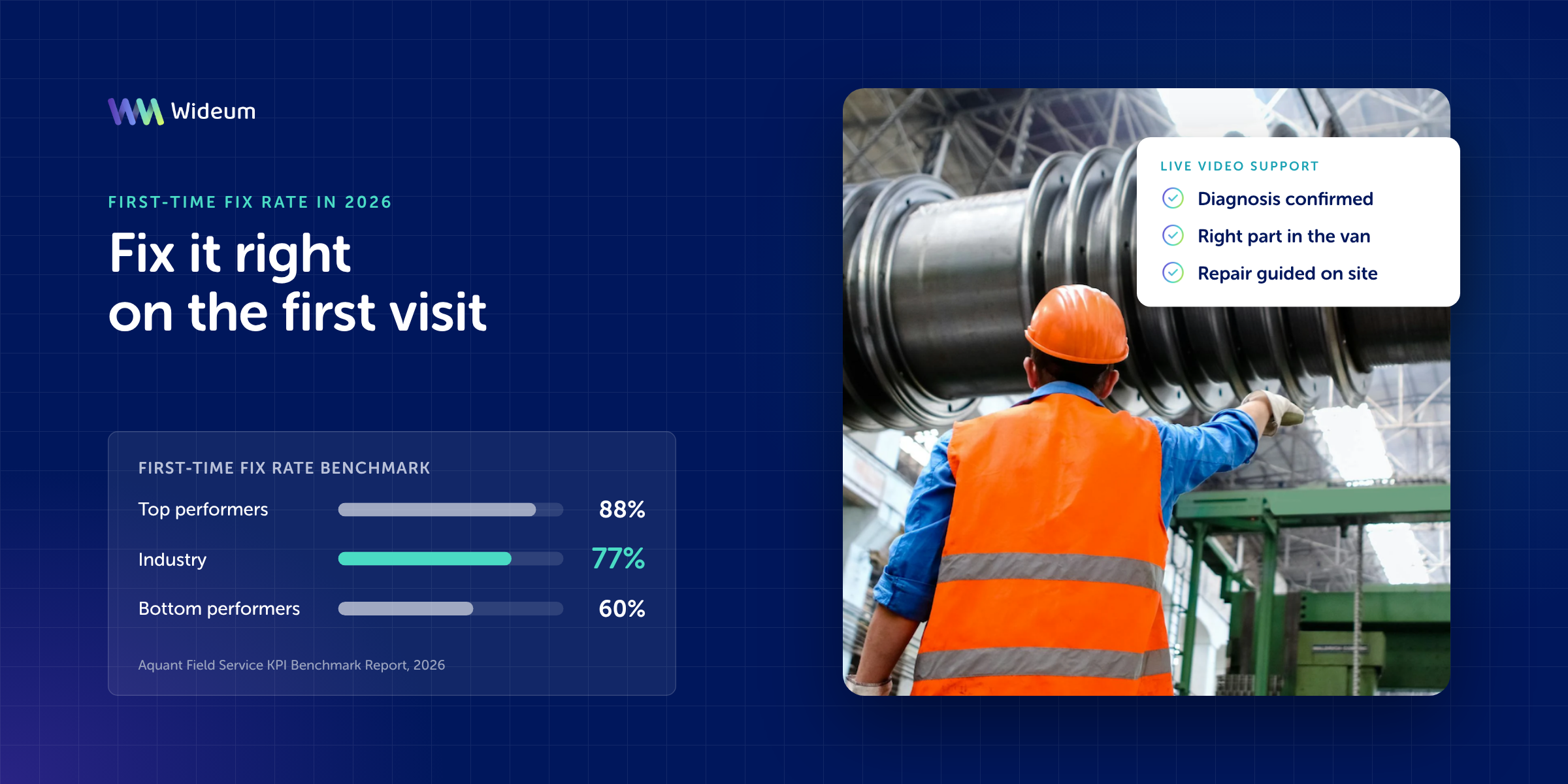
First-time fix rate is the share of service jobs fully resolved on the first visit, and Aquant’s 2026 benchmark puts the industry rate at 77%. VSight defines First Time Fix Rate (FTFR) as the percentage of service jobs resolved completely on the first visit, with no follow-up visit required (VSight). Aquant’s 2026 Field Service KPI Benchmark Report puts the industry first-time fix benchmark at 77%, top-performing companies at 88% and bottom performers at 60% (Aquant, 2026).
The benchmark analysed anonymised performance data from 161 service organisations. That data covers nearly 30 million service events, 7 million assets and $8.3 billion in service costs over three years (Aquant, 2026). Its findings are best read alongside your own service data.
Why technicians fail on the first visit
In our view, repeat visits usually come from three linked gaps: wrong diagnosis, missing parts and missing know-how. We see them as connected, so fixing only one of them is unlikely to move the metric much.
Wrong or incomplete diagnosis
A wrong diagnosis sends the wrong technician, with the wrong parts, to the wrong task. Field Service News reports that poor asset records, incomplete service histories and inaccurate parts information can slow diagnosis and create repeat visits (Field Service News).
In our view, a fault described over the phone by a machine operator is an unreliable basis for dispatch, and a short video assistance session before the visit gives a more reliable one. The expert sees the asset, the nameplate, the error code and the operating conditions before anyone gets in a van.
Missing parts
We see a missing part as often being a diagnosis problem that only shows up once the technician is on site. If triage identifies the wrong component, the van stock is wrong too, however good the logistics. In a 2022 report, Valuates Reports described AR/VR as letting service technicians identify a problem in advance and arrive prepared with tools and spare parts (Valuates Reports, 2022).
Missing know-how
In our view, missing know-how is the cause live video support addresses most directly. The knowledge often exists within the organisation, just not with the person on site.
Aquant’s 2026 benchmark measures a ‘skills gap’: the difference in first-time fix rates between top technicians and everyone else. The gap is 2.9 percentage points in best-in-class teams and 10 points in underperforming teams, where knowledge is concentrated in a few technicians (Aquant, 2026).
When only a few senior technicians can solve a given fault, that fault cannot be fixed on the first visit unless one of them attends. A remote technician on a live video call removes that constraint without sending the expert to site.
What a failed first visit costs
Failed visits account for 25% of total service cost at the median, according to Aquant’s 2026 benchmark. The same report puts that share at 44% for bottom performers and 14% for top performers (Aquant, 2026).
A separate metric in the same benchmark measures how long it takes to close a case, not what it costs. Industry mean time to resolution is 4.5 days, compared with 2.5 days for top performers and 10 days for bottom performers (Aquant, 2026).
Aquant also estimates potential service cost savings of up to 26% in some segments, up from 23% last year (Aquant, 2026). This is an estimate of potential savings, not a measured result.
How live video support solves the problem during the first visit
Live video support lets a remote expert guide the repair through the technician’s camera, and take control of the machine’s PC when the fault is in software, so the visit can end with a fix. Wideum’s Remote Eye provides immediate live video remote assistance (Wideum). Its Remote Desktop add-on lets the remote expert take control of the machine’s PC (Wideum).
Before dispatch: triage on video
Remote Eye runs on smart glasses, phones and tablets. A first video assessment can therefore start with whatever device is available on site.
Aquant’s figure that 1 in 5 cases could be resolved remotely is a reason to make this step part of the standard process rather than an exception (Aquant, 2026). If the case still needs a visit, the expert can already have confirmed the fault and the parts.
During the visit: expert guidance in real time
The expert sees the technician’s view live. They place augmented reality annotations on the image to show exactly which component, connector or valve to work on.
Wideum advertises Remote Eye with a simultaneous multilingual voice translator (Wideum). This is useful when the expert and the technician do not share a language. Remote Eye also translates text and is designed to keep working on poor connections, which matters in basements, plant rooms and remote sites.
The AI Technical Assistant add-on for Remote Eye and Process Eye answers questions from the customer’s own manuals and reports (Wideum). It cites the source document for each answer, so the technician can check it.
After the visit: turning the fix into a procedure
Some fixes are likely to recur. In those cases, the steps the expert used can be written up as a Process Eye procedure.
Process Eye guides technicians step by step on smart glasses, phones and tablets, including offline. Its AI reviews photos and readings, and each job generates a traceable report. Over time, this spreads know-how beyond the few experts who hold it.
Deployment and security
Remote Eye and Process Eye can be deployed in three ways:
- in the cloud;
- on the customer’s own servers;
- on a private network without internet access.
Wideum provides an API, SSO and integrations with ERP, CRM, CMMS and WMS systems. The company holds ISO 27001 and SOC 2 certifications.
Field devices: RealWear Navigator 520 and Vuzix M400
Both devices are head-worn, so the technician does not have to hold a camera during the repair. The Navigator 520 is designed around voice control in loud, harsh workplaces, and the M400 integrates out of the box with mainstream meeting tools.
RealWear Navigator 520
RealWear describes the Navigator 520 as a rugged, voice-controlled assisted reality headset for frontline workers. It can be worn around the head or attached to a hard hat (RealWear).
According to RealWear, it offers:
- an IP66 rating, MIL-STD-810H certification and an operating range from -20°C to 45°C (RealWear);
- a 50 MP tiltable camera that can be swapped for an optional FLIR thermal camera module (RealWear);
- hot-swappable batteries that can be replaced in the field without powering down the device (RealWear);
- two internal speakers and four noise-cancelling microphones (up to 100 dB) for voice control and calls in loud workplaces (RealWear).
Illustrative scenario: a technician wearing a hard hat services a pump in a loud plant room. They start a Remote Eye call. The expert asks them to tilt the camera towards a terminal block, then marks the faulty connection on screen. The battery can be changed mid-job without powering down the device.
Vuzix M400
Vuzix describes the M400’s remote assistance use case as connecting frontline workers with experts who see what they see, without travel or handheld video (Vuzix).
According to Vuzix, the M400:
- has IP67 water and dust protection, 2-metre drop safety and a wide operating temperature range (Vuzix);
- integrates out of the box with Zoom, Microsoft Teams and WebEx, and pairs with the Vuzix Remote Assist Kit (Vuzix).
Vuzix states that the M400 will remain on Android 13, with routine OS security updates no longer planned (Vuzix). Factor this into lifecycle and IT security planning before a large rollout.
Illustrative scenario: a technician in a dusty, wet outdoor installation cannot hold a phone while working. They stream the job to a remote expert through the M400 and keep both hands on the equipment.
Comparison table
Specifications below come from each manufacturer’s website (RealWear; Vuzix). Wideum supplies both devices configured for Remote Eye and Process Eye, with support included.
| Feature | RealWear Navigator 520 | Vuzix M400 |
|---|---|---|
| Form factor | Voice-controlled assisted reality headset, worn around the head or on a hard hat | Smart glasses for remote assistance without handheld video |
| Ingress protection | IP66 | IP67 |
| Ruggedness | MIL-STD-810H certified | 2-metre drop safety |
| Operating temperature | -20°C to 45°C | Wide operating temperature range |
| Camera | 50 MP tiltable, swappable for optional FLIR thermal module | — |
| Audio | 2 speakers, 4 noise-cancelling microphones (up to 100 dB) | — |
| Battery | Hot-swappable in the field | — |
| Collaboration integrations | — | Zoom, Microsoft Teams, WebEx; Vuzix Remote Assist Kit |
| Operating system | — | Stays on Android 13; routine OS security updates no longer planned |
| Best fit (editorial) | Loud, harsh sites; hard hat users; jobs where thermal imaging helps diagnosis | Wet or dusty sites; teams already using Zoom, Teams or WebEx; deployments where staying on Android 13 is acceptable |
“—” means the item could not be confirmed.
Common mistakes when trying to raise first-time fix rate
In our view, programmes often stall when they treat remote assistance as an add-on rather than changing how jobs are triaged and dispatched.
| Problem | Solution |
|---|---|
| Dispatching on the basis of a phone description | Make a short video triage session the default step before dispatch |
| Expert calls only when the technician is already stuck | Agree escalation rules so the expert joins early on unfamiliar assets |
| Technicians holding a phone while working | Use hands-free smart glasses so both hands stay on the equipment |
| Each solved fault stays in one expert’s head | Turn recurring fixes into step-by-step procedures |
| Choosing devices on specifications alone | Check noise, PPE, ingress protection and support lifecycle against your real sites |
A practical plan to raise your first-time fix rate
Start with measurement, then move knowledge to the point of repair.
- Measure your current first-time fix rate with a clear definition. Split failed visits by cause: diagnosis, parts or know-how.
- Identify the assets and fault types with the most repeat visits, and the technicians who usually solve them.
- Add video triage before dispatch for those fault types.
- Equip field technicians with hands-free smart glasses suited to their environment, and give experts a live video support console.
- Use remote desktop access for faults in machine software, so that software issues need not require an extra visit.
- Convert recurring fixes into guided procedures, and review the metric monthly.
To test this workflow on your own assets, Wideum offers a free trial of Remote Eye, and its team can be contacted through wideum.com.
Key points
- Aquant’s 2026 benchmark puts the industry first-time fix rate at 77% (Aquant, 2026).
- Failed visits account for 25% of total service cost at the median in Aquant’s 2026 benchmark (Aquant, 2026).
- In underperforming teams, the first-time fix gap between top technicians and everyone else is 10 points (Aquant, 2026).
- Poor asset records, incomplete service histories and inaccurate parts information can slow diagnosis and create repeat visits (Field Service News).
- Remote Eye provides immediate live video remote assistance (Wideum). Its Remote Desktop add-on lets the expert take control of the machine’s PC (Wideum).
- The RealWear Navigator 520 is a voice-controlled headset with hot-swappable batteries (RealWear).
- The Vuzix M400 integrates out of the box with Zoom, Microsoft Teams and WebEx (Vuzix).
FAQ
What is a good first-time fix rate in 2026?
Aquant’s 2026 benchmark places top-performing companies at 88% and bottom performers at 60% (Aquant, 2026). Compare your own rate against companies with similar assets and service models.
What causes most repeat field service visits?
In our view, repeat visits usually stem from a wrong diagnosis, missing parts or missing know-how on site. Field Service News reports that poor asset records, incomplete service histories and inaccurate parts information can slow diagnosis and create repeat visits (Field Service News).
Can a remote expert fix a fault without travelling to site?
Yes, when the fault is in configuration or software that can be reached from the machine’s PC. Wideum’s Remote Desktop add-on lets the remote expert take control of the machine’s PC (Wideum). In a 2022 report, Valuates Reports stated that remote diagnosis and repair with AR/VR devices reduces travel costs and the need for skilled technicians to be on site (Valuates Reports, 2022). Physical repairs still need someone on site, but that person need not be the expert.
Why use smart glasses rather than a phone for video assistance?
Head-worn smart glasses avoid the need to hold a phone, leaving both hands free for the work. Vuzix describes the M400’s remote assistance use case as connecting frontline workers with experts who see what they see, without travel or handheld video (Vuzix).
Which smart glasses suit noisy or harsh industrial sites?
RealWear describes the Navigator 520 as a rugged, voice-controlled headset that can be attached to a hard hat (RealWear). Its noise-cancelling microphones are designed for voice control and calls in loud workplaces (RealWear). The Vuzix M400 offers water and dust protection and drop safety, according to Vuzix (Vuzix).
Does live video support work across languages and on weak connections?
Wideum advertises Remote Eye with a simultaneous multilingual voice translator (Wideum). Remote Eye also translates text and is designed to work on poor connections.
Sources
- Aquant’s 2026 Field Service Benchmark: Companies Can Unlock up to 26% in Service Cost Savings by Scaling Knowledge Across the Workforce
- First Time Fix Rate (FTFR): Formula & Benchmarks | VSight
- The Conversations Changing Service in 2027 — According to 100 … — Field Service News
- Field Service Management Market Size to Reach USD 24,294.0 Million by 2030 at CAGR 19.7% – Valuates Reports
- Buy Vuzix M400 Smart Glasses for Remote Support — Wideum
- RealWear Navigator 520
- Vuzix M400 | Wearable, Powerful, Smart Glasses – Vuzix Corporation