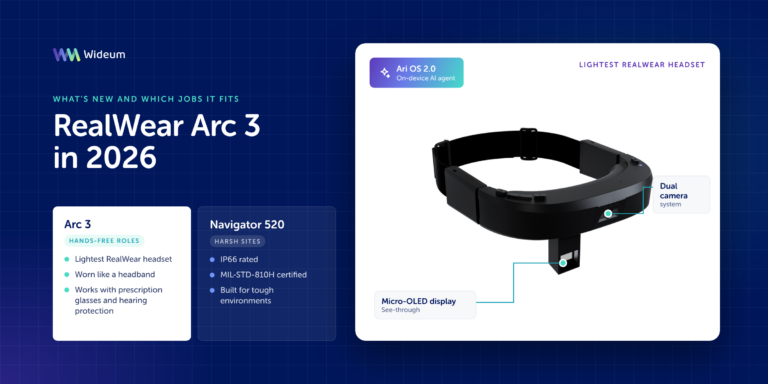





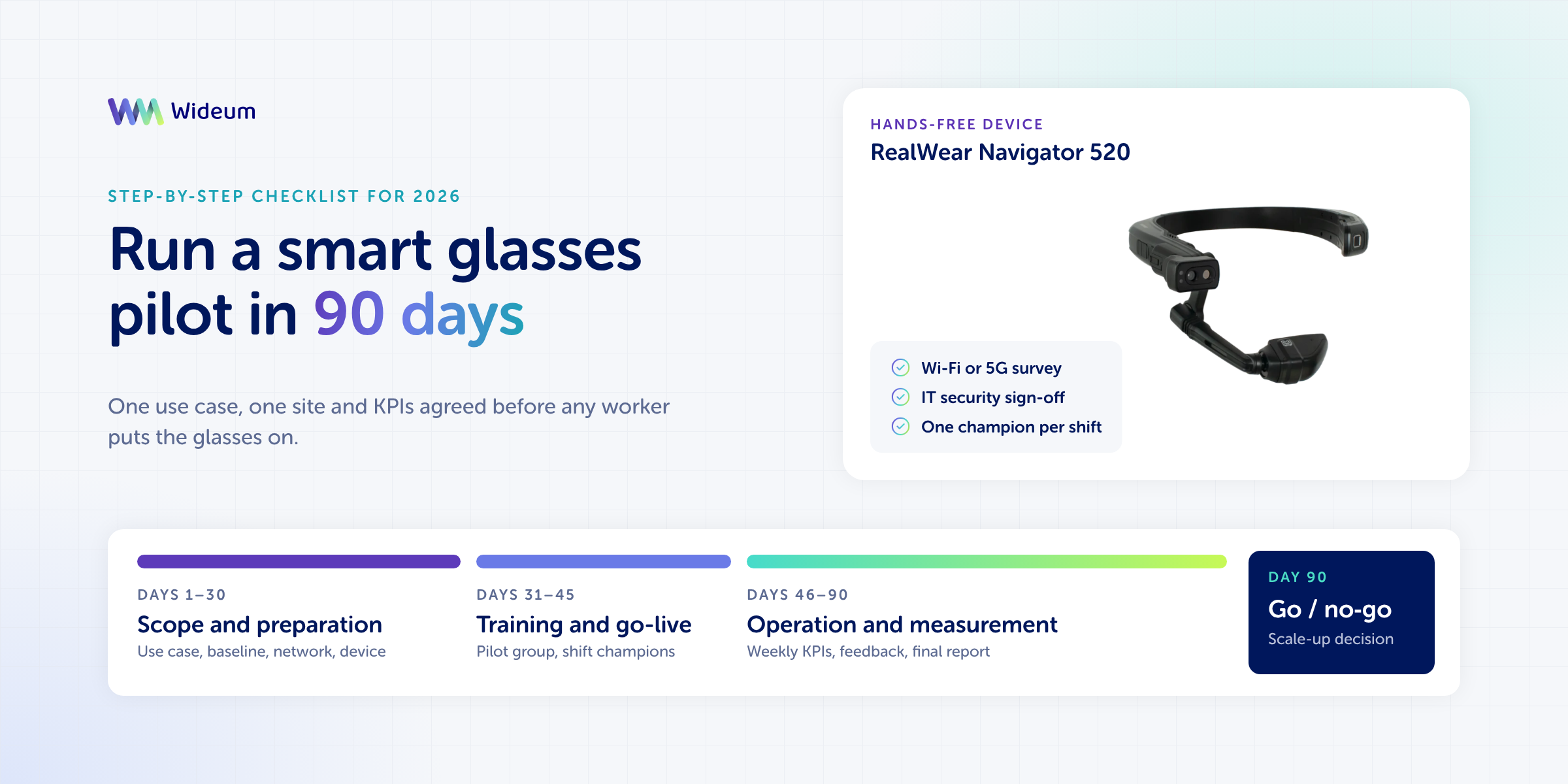
A 90-day smart glasses pilot works when it tests one use case at one site and settles connectivity, IT security and device choice before any worker puts the glasses on. Use the first month for preparation, the second for training and go-live, and the third for measuring KPIs agreed in advance. On hardware, RealWear describes the Navigator 520 as a rugged, voice-controlled headset for frontline workers in demanding environments (RealWear). Vuzix positions the M400 for on-demand, hands-free use across changing tasks, users and outdoor environments (Vuzix).
Updated: 17 November 2026
The 90-day plan at a glance
The pilot runs in three phases of roughly 30 days each and ends with a go/no-go decision on day 90. The timings below are a planning template from Wideum’s editorial team, not a benchmark. Adjust them to your site and team.
| Phase | Days | Main deliverables |
|---|---|---|
| Scope and preparation | 1–30 | One use case, baseline measurements, Wi-Fi or 5G survey, IT security sign-off, device selected |
| Training and go-live | 31–45 | Trained pilot group, one champion per shift, first live sessions |
| Operation and measurement | 46–90 | Weekly KPI tracking, user feedback, final report and scale-up decision |
Why readiness matters as much as the hardware
Plan organisational readiness and worker adoption as explicitly as the technical set-up. A systematic review in Discover Applied Sciences (Springer Nature) studied augmented reality adoption in maintenance. It covered 80 peer-reviewed articles and grey literature sources published between 2017 and 2025 (Discover Applied Sciences, 2025). The review analysed 28 implementation-focused studies. Of these, 85% focused on hardware and 89% on software. Cost considerations (32%) and geographic factors (18%) remained underexplored (Discover Applied Sciences, 2025). The review concludes that organisational readiness and human factors are as critical as technological capabilities for AR adoption outcomes (Discover Applied Sciences, 2025).
For that reason, this checklist gives training, change management and KPIs the same weight as devices and networks.
Step 1 (days 1–15): pick one use case and measure the baseline
Choose a single task that is frequent and measurable, and where hands-free access to an expert or a procedure saves time. Typical starting points, and the Wideum software that covers each one:
- Remote video assistance: a field technician or line operator shares live video with a remote expert, who guides the fix with augmented reality annotations. This is the Remote Eye use case, which also offers simultaneous voice and text translation.
- Guided procedures and inspections: step-by-step instructions appear on the glasses, AI checks photos and readings, and every job produces a traceable report (Process Eye).
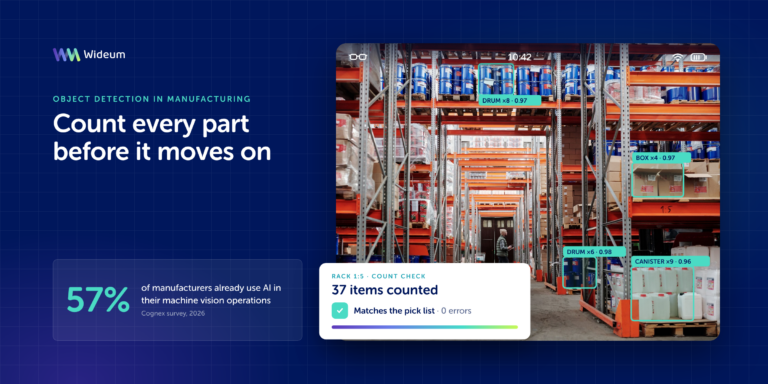
- Voice picking: workers prepare orders by voice and camera on smart glasses, with integration into the WMS or ERP (Picking Eye).
Record how the task performs today before go-live. Measure how long it takes, how often an expert has to travel, and how many errors or repeat visits occur. Without this baseline, you have nothing to compare the day-90 results against.
Name a business owner, an IT owner and a site lead for the pilot. Keep the pilot group small: one team on one site is easier to support than several sites at once.
Step 2 (days 10–30): prepare Wi-Fi or 5G coverage
Survey the actual working areas, not the office, and test video calls where the work happens. Pay particular attention to metal structures, cold rooms, basements and outdoor yards.
Check which bands your access points use against the device specification. RealWear lists Wi-Fi 802.11 a/b/g/n/ac on both the 2.4 GHz and 5 GHz bands for the Navigator 520 (RealWear). Where Wi-Fi cannot reach, a public or private 5G network or a mobile hotspot can close the gap. Test that option with the same video assistance session you plan to run in production.
The software also affects how much coverage you need:
- Remote Eye is designed to keep working on poor connections.
- Process Eye runs procedures offline, so a dead zone does not stop a guided task.
- Wideum can be deployed in the cloud, on your own servers or on a private network without internet access. This choice determines what IT has to open in the firewall.
Step 3 (days 10–30): get IT security sign-off early
Treat the glasses as managed endpoints and involve IT security in week one, not after the devices arrive. Cover these points in the security review:
- Device management: agree how devices are enrolled, configured and wiped. RealWear uses Ari Cloud for centralised deployment and management of the Navigator 520 (RealWear). Vuzix states that the M400 supports development against enterprise MDM platforms including Intune, SOTI MobiControl and AirWatch (Vuzix).
- Hardware security: RealWear lists Qualcomm Trusted Execution Environment, Secure Boot and a Crypto Engine among the Navigator 520’s security features (RealWear).
- Operating system lifecycle: compare the vendor’s OS update policy with your internal patching rules. The 2026 section below covers this.
- Software and data: Wideum holds ISO 27001 and SOC 2 certifications and supports SSO, API access and integrations with ERP, CRM, CMMS and WMS. Agree where video, images and reports are stored and who can access them.
- Camera policy: define where recording is allowed, especially near confidential processes or where other people are in view.
Step 4 (days 15–30): choose the right smart glasses for the pilot
Match the device to site conditions. Choose the RealWear Navigator 520 for loud, harsh environments and hard-hat work. Choose the Vuzix M400 for on-demand use across changing tasks and outdoor field work.
The table only includes specifications published on each manufacturer’s website (RealWear; Vuzix). A dash means the item could not be confirmed.
| Criterion | RealWear Navigator 520 | Vuzix M400 |
|---|---|---|
| Manufacturer positioning | Rugged, voice-controlled assisted reality headset for frontline workers in demanding environments | On-demand use rather than whole-shift wear, for teams needing hands-free capabilities across changing tasks, users and outdoor environments |
| Ruggedness | IP66 and MIL-STD-810H; designed to withstand dust, water, drops and temperatures from −20°C to 45°C | IP67 protection against water and dust, 2-metre drop safety and a wide operating temperature range |
| Voice and audio in noise | Four noise-cancelling microphones rated up to 100 dB and two internal speakers | — |
| Battery | Hot-swappable batteries, replaceable in the field without powering down | M400 Xtreme kit adds a 3,200 mAh battery built for −20°C to 45°C, recommended for outdoor or inclement-weather field work |
| Camera | 48 MP tiltable camera; optional FLIR thermal camera module | — |
| Wearing options | Around the head or on a hard hat | — |
| Fleet and app integration | Ari Cloud for centralised deployment and management | Zoom, Microsoft Teams and WebEx out of the box; supports development against Intune, SOTI MobiControl and AirWatch MDM |
| Operating system support | — | Remains on Android 13; product and technical support planned through 31 December 2028 |
| Best fit for a pilot (Wideum assessment) | Noisy plants, heavy industry, oil and gas, and sites where hard hats and hearing protection are mandatory | Field service and logistics teams that use the glasses for specific tasks rather than the whole shift |
Vuzix positions the M400 for on-demand rather than whole-shift use. For continuous work, Vuzix points to its LX1 smart glasses (Vuzix), which are not among the models Wideum currently supplies.
If neither profile fits your site, Wideum also supplies the Epson Moverio BT-45CS, Rokid X-Craft and Moziware Cimo. All of these come configured for Remote Eye and Process Eye, with support included.
Step 5 (days 31–45): train workers and appoint champions
Train in short, hands-on sessions at the workstation, and appoint one champion per shift who can answer first-line questions. Cover these topics:
- Fit and comfort
- Voice commands
- Starting a video assistance call
- Following a procedure
- Privacy rules
- Battery handling and cleaning
Check the glasses with each worker’s real PPE during training. RealWear states that the Navigator 520 is compatible with helmets, safety or prescription eyewear, hearing protection and external headphones (RealWear).
Remote experts also need training: guiding someone through a camera feed is a different skill from fixing the machine yourself. Collect structured feedback from the first week onwards, so you can fix usability problems before they turn into low adoption.
Step 6 (days 46–90): run the pilot and track KPIs
Pick three to five KPIs before go-live, tie each one to the step 1 baseline, and review them every week. The list below is an editorial selection by use case, not a set of target values.
| KPI | What it measures | Use case it fits best |
|---|---|---|
| Mean time to resolve | Time from incident to fix | Remote video assistance |
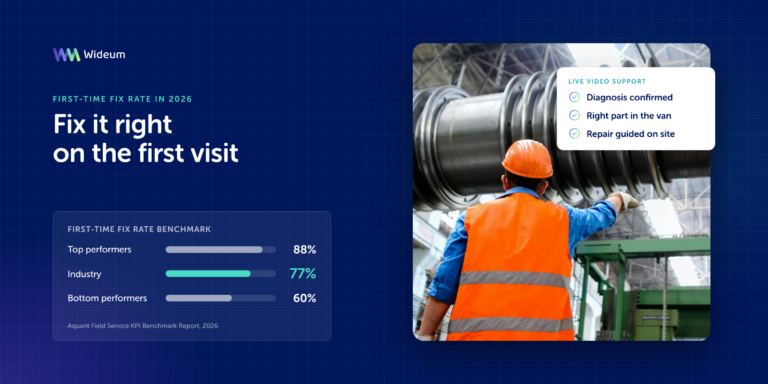
| First-time fix rate | Share of jobs solved without a return visit | Field service |
| Expert trips avoided | Travel replaced by remote sessions | Equipment manufacturers supporting installed machines |
| Errors per task or audit findings | Quality of guided work | Procedures and inspections |
| Picking accuracy and lines per hour | Order preparation performance | Voice picking |
| Adoption | Sessions per user per week and voluntary use | All pilots |
| User satisfaction | Comfort and usefulness, from worker surveys | All pilots |
Close the pilot on day 90 with a short report that contains:
- KPI results against the baseline
- Total cost of the pilot
- User feedback
- A clear recommendation to scale, extend or stop
Smart glasses device lifecycle in 2026: what to check before you scale
Before moving from pilot to rollout, check that the device’s software support covers your planned deployment period. This matters most for the Vuzix M400.
Vuzix states that the M400 will remain on Android 13 and that routine OS security updates are no longer planned. Vuzix will evaluate critical or severe security issues during the support period (Vuzix). M400 product and technical support is planned to continue through 31 December 2028 (Vuzix).
Vuzix recommends its LX1 smart glasses to customers who need routine OS security updates or an operating system beyond Android 13 (Vuzix). If your IT policy requires regular OS patches, raise this in the step 3 review. A pilot can still run on the M400, but the rollout plan has to take its lifecycle into account.
Common mistakes and how to avoid them
| Mistake | Solution |
|---|---|
| Testing several use cases at once | Start with one task, one site and one team, then expand |
| Starting without a baseline | Measure current times, trips and errors in the first two weeks |
| Checking coverage only in offices | Test video calls in the real working areas and on every shift |
| Bringing in IT security after purchase | Run the security review in parallel with use-case selection |
| Choosing glasses before checking PPE and noise levels | Test the device with real helmets, safety glasses and ambient noise |
| Measuring only technical metrics | Track adoption and user satisfaction alongside time and quality |
To run this plan with Remote Eye, Process Eye or Picking Eye, Wideum offers a free trial. It can also supply the RealWear Navigator 520 or Vuzix M400 configured and ready to use.
Key points
- A 90-day pilot covers one use case and one site, with a baseline measured before go-live and three to five KPIs agreed in advance.
- A 2025 systematic review of AR in maintenance found that 85% of the 28 implementation studies it analysed focused on hardware and 89% on software. Organisational factors such as cost (32%) remained underexplored (Discover Applied Sciences, 2025).
- The same review concludes that organisational readiness and human factors are as critical as technology for AR adoption outcomes (Discover Applied Sciences, 2025).
- RealWear states that the Navigator 520 is IP66-rated and MIL-STD-810H certified, and uses hot-swappable batteries (RealWear).
- Vuzix states that the M400 is IP67-rated and supports development against Intune, SOTI MobiControl and AirWatch MDM (Vuzix).
- Vuzix no longer plans routine OS security updates for the M400 and will evaluate critical or severe issues during the support period (Vuzix).
FAQ
How long should a smart glasses pilot run?
We recommend around 90 days for a first pilot. That allows a month to prepare the network, security and devices, two weeks to train, and six weeks of live use to collect KPI data across several shifts.
Which use case is best for a first smart glasses pilot?
Start with a frequent task where hands-free help clearly saves time and is easy to measure. Common choices are remote video assistance for technicians, guided inspections and voice picking in warehouses. Avoid rare, one-off jobs: they do not produce enough data within 90 days.
Should we choose RealWear or Vuzix for a noisy plant?
For loud sites, the RealWear Navigator 520 is the more natural fit. RealWear states it has four noise-cancelling microphones rated up to 100 dB, which keep voice control and calls reliable in loud workplaces (RealWear). Vuzix positions the M400 for on-demand use across changing tasks and outdoor work (Vuzix).
Do smart glasses need 5G for video assistance?
Not necessarily. Good Wi-Fi coverage in the working areas is often enough, and RealWear lists dual-band 2.4 GHz and 5 GHz Wi-Fi for the Navigator 520 (RealWear). 5G or a hotspot helps where Wi-Fi cannot reach. Remote Eye is designed to keep working on poor connections.
Which KPIs prove that a smart glasses pilot worked?
Use KPIs tied to your baseline: mean time to resolve, first-time fix rate, expert trips avoided, errors per task, or picking accuracy, depending on the use case. Add adoption and user satisfaction. A pilot with good technical results but low voluntary use is not ready to scale.
Can workers wear smart glasses with a hard hat and safety glasses?
With the RealWear Navigator 520, yes. RealWear states it can be worn around the head or attached to a hard hat (RealWear). It is also compatible with helmets, safety or prescription eyewear, hearing protection and external headphones (RealWear). For other models, test them with your PPE during training.
Sources
- RealWear Navigator 520
- Vuzix M400 | Wearable, Powerful, Smart Glasses – Vuzix Corporation
- A systematic review of different adoption strategies for augmented reality in maintenance: bridging theory and practice | Discover Applied Sciences | Springer Nature Link