







Industrial AI smart glasses turn hands-free voice control, live video and AI-assisted computer vision into measurable gains for quality control, remote assistance and training. Market researchers put 2025 global AI smart glasses revenue between $2.47 billion and $2.9 billion, with growth forecasts of 8.5% to 11.6% a year through the mid-2030s (Polaris Market Research, Straits Research, InsightAce Analytic, 2026). Rugged devices such as the RealWear Navigator 500 and the Vuzix M400 are the models industrial buyers evaluate often, each with its own price, ruggedness rating and support horizon.
Updated: October 6, 2026
Why Industrial AI Smart Glasses Are Gaining Traction in 2026
Industrial AI smart glasses are gaining traction in 2026 because shipment growth, falling average prices and documented efficiency gains in quality control and remote assistance are converging at the same time. The broader smart glasses category, which includes consumer eyewear as well as enterprise devices, shipped around 2.25 million units in a single quarter (Q1 2026), up 167% year over year, according to IDC’s Worldwide Quarterly Wearable Device Tracker and Worldwide Quarterly Augmented and Virtual Reality Headset Tracker (IDC, 2026). Within that category, IDC forecasts full-year 2026 shipments of about 13.6 million display-less smart glasses units, rising to 27.3 million units by 2030, an 18.9% compound annual growth rate (IDC, 2026). Separately, the segment IDC links most closely to enterprise and spatial-computing buyers — optical see-through display glasses — is forecast to grow from 3 million units in 2026 to 12.2 million units by 2030, a 41.9% CAGR (IDC, 2026). Across the whole smart glasses category and its segments, volume is led by consumer models such as Meta’s Ray-Ban line, so these figures should be read as market-wide momentum rather than an industrial-only breakdown.
AI Smart Glasses Market Size and Growth: What the Data Shows
The global AI smart glasses market was valued between $2.47 billion and $2.9 billion in 2025, depending on the research firm, with 2026-era compound annual growth projections between roughly 8.5% and 11.6%. Straits Research values the global AI smart glasses market at $2.58 billion in 2025, projecting growth to $2.80 billion in 2026 and $5.42 billion by 2034, an 8.6% CAGR for 2026-2034; the same report credits North America with a 44.65% share in 2025 (Straits Research, 2026). Polaris Market Research values the market at $2.47 billion in 2025, estimates $2.68 billion for 2026 and projects $5.16 billion by 2034, an 8.54% CAGR for 2026-2034; it credits North America with a 37.0% share in 2025, forecasts a 13.60% CAGR for Asia Pacific, puts the Consumer Electronics segment at a 44.0% share, and projects a 12.40% CAGR for the Healthcare segment (Polaris Market Research, 2026). InsightAce Analytic values the market at $2.9 billion in 2025, projecting $8.4 billion by 2035 at an 11.6% CAGR for 2026-2035 (InsightAce Analytic, 2026). These three estimates differ because they come from separate research firms; none of the source reports explains the gap, so this article does not speculate on the cause.
On the investment side, Vuzix Corporation received a $20 million strategic investment from Quanta Computer in March 2025 to expand waveguide manufacturing capacity and support mass-market AI smart glasses production, according to Straits Research’s tracking of 2025 funding activity (Straits Research, 2026). For industrial buyers, that kind of manufacturing investment is a useful signal of a vendor’s ability to sustain long-term enterprise supply.
Measured Productivity, Training and Safety Benefits in Industry
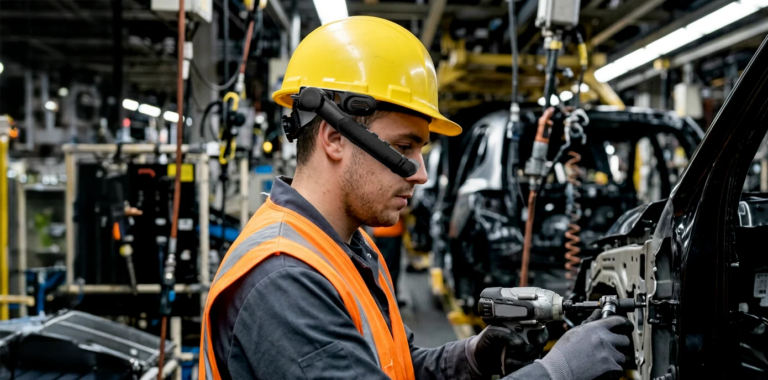
Independent studies on industrial smart glasses report concrete gains in inspection reliability and safety response, though most published evidence so far comes from controlled pilots rather than large-scale rollouts. Researchers at Instituto Politécnico de Viseu and the Pontifical University of Salamanca built a system that combines a smart glasses video feed with a YOLOv8 object-detection model for real-time quality inspection during an assembly process. Tested in a controlled environment, the combination of mixed reality and computer vision was found to meaningfully improve the speed and accuracy of defect detection compared with conventional manual inspection (MDPI, Validating the Use of Smart Glasses in Industrial Quality Control: A Case Study, 2024). The scope of this result is a controlled assembly-line quality-control setting, not a claim about industrial inspection generally.
Separately, a pilot study connected Vuzix Blade smart glasses to a cloud-based architecture in an oil-extraction plant to build an augmented-reality safety application. The system gave operators step-by-step guidance, remote-operator support and real-time alerts in hazardous situations; the pilot validated the approach but identified battery life and device overheating as the main usability constraints under field conditions (Prist et al., Augmented Reality Smart Glasses in the Workplace: Safety and Security in the Fourth Industrial Revolution Era, 2020). This was a single-plant pilot, so the result should be read as a proof of concept rather than an industry-wide benchmark.
RealWear Navigator 500: Specs, Ruggedness and Price
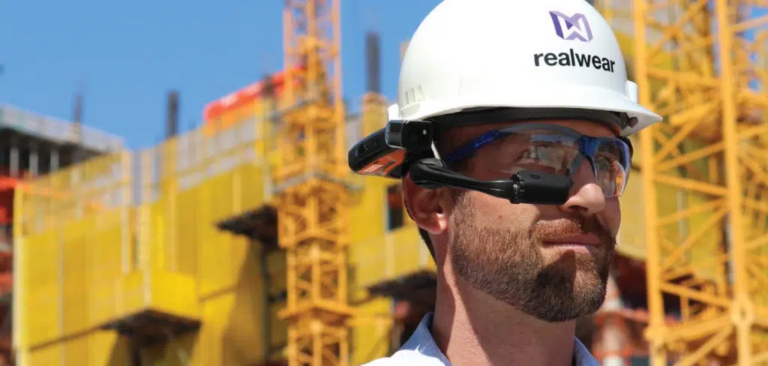
The RealWear Navigator 500 is a voice-controlled, head-worn Android device built for hands-free use in harsh industrial environments, carrying IP66 and MIL-STD-810H ruggedness ratings. According to RealWear’s own device specifications, the Navigator 500 runs Android 13 (AOSP) with the WearHF hands-free interface on a 2.0 GHz 8-core Qualcomm Snapdragon 662 chipset, 64 GB of internal storage and 4 GB of RAM, and weighs 270 g (9.5 oz) (RealWear, 2026). It is rated IP66 and MIL-STD-810H, and survives a 2-meter (6.5-foot) drop. The display is a 20-degree field-of-view, 24-bit color LCD at WVGA resolution (854 x 480), and the camera is a 48 MP sensor with PDAF and LED flash, recording up to 1080p at 60 fps (RealWear, 2026). The battery is a 2,600 mAh / 10.0 Wh Li-polymer pack that is hot-swappable, and connectivity includes Bluetooth 5.1 and dual-band 802.11 a/b/g/n/ac Wi-Fi (RealWear, 2026). Pricing for the Navigator 500 could not be confirmed on the manufacturer’s own site at the time of writing; buyers typically request a quote through RealWear’s authorized reseller network.
Vuzix M400: Specs, Support Timeline and Price
The Vuzix M400 is an Android smart glasses platform with manufacturer-confirmed support through December 31, 2028, and a list price of $1,499.99 for the M400 Xtreme Kit configuration. Per Vuzix’s own product page, the M400 operating system will remain on Android 13, and Vuzix plans to maintain enterprise applications such as Zoom, Microsoft Teams and Mobilium through the same end date, December 31, 2028 (Vuzix Corporation, 2026). The M400 Xtreme Kit, priced at $1,499.99, bundles the M400 smart glasses with a 3,200 mAh Xtreme Weather battery rated IP67, an all-day comfort headband, charging and power cables, a carrying case and a one-year manufacturer’s warranty (Vuzix Corporation, 2026). That price and the IP67 rating apply specifically to this Xtreme Kit bundle, not to a bare M400 unit sold without the kit. Vuzix also notes that customers who need an operating system beyond Android 13 or routine OS security updates are directed toward its Vuzix LX1 glasses (Vuzix Corporation, 2026).
Vuzix Blade 2: A Lighter-Weight Alternative
The Vuzix Blade 2 is a lighter, glasses-style AR device aimed at the deskless workforce, launched at $1,299.99 with Android 11 and ANSI Z87.1 safety-certified lenses. Announced by Vuzix Corporation in August 2022, the Blade 2 runs on Android 11, offers 40 GB of integrated storage, dual-band Wi-Fi (2.4 GHz and 5 GHz) and Bluetooth connectivity, see-through waveguide optics for a 24-bit color display, noise-cancelling microphones, in-temple stereo speakers and an HD camera, and carries full UV-protection lenses with ANSI Z87.1 certification for occupational eye protection (Vuzix Corporation, 2022). It list-priced at $1,299.99 for general availability (Vuzix Corporation, 2022).
Comparing the Three Devices
| Device | OS | Weight | Ruggedness | Battery | List price | Best for |
|---|---|---|---|---|---|---|
| RealWear Navigator 500 | Android 13 (AOSP) | 270 g (9.5 oz) | IP66, MIL-STD-810H, 2 m drop | 2,600 mAh / 10.0 Wh, hot-swappable | Not confirmed on manufacturer site | Heavy industrial sites, hands-free voice navigation |
| Vuzix M400 (Xtreme Kit) | Android 13 | Not confirmed on manufacturer site | IP67 (Xtreme Weather battery) | 3,200 mAh (Xtreme Weather battery) | $1,449.99 | Rugged outdoor and field-service work |
| Vuzix Blade 2 | Android 11 | Not confirmed on manufacturer site | ANSI Z87.1 certified lenses | Not confirmed on manufacturer site | $799 | Lightweight, all-day wear for deskless staff |
For the harshest industrial environments — outdoor plants, confined spaces, PPE-heavy sites — the RealWear Navigator 500 is the strongest fit of the three, combining the ruggedness rating with a fully hands-free, voice-controlled interface designed for workers who cannot touch a screen.
Common Mistakes When Deploying Industrial Smart Glasses
The most common deployment mistake is assuming lab-rated battery life and thermal performance will hold up unchanged in real field conditions. A 2020 pilot that connected Vuzix Blade smart glasses to a cloud safety system in a oil-extraction plant specifically flagged battery life and device overheating as the main constraints once the hardware left controlled testing (Prist et al., 2020). The practical solution is to run a short field pilot under the actual temperature, humidity and shift-length conditions of the target site before committing to a full rollout.
A second mistake is locking a software rollout to a single hardware vendor before testing the workflow. Wideum’s Remote Eye, for remote video assistance, and Process Eye, for step-by-step task guidance, run on RealWear, Vuzix and Moziware smart glasses as well as on standard smartphones and tablets, which lets a team pilot the workflow on whatever device is already on hand before standardizing on a specific headset.
Key Takeaways
- Global AI smart glasses market revenue for 2025 is estimated between $2.47 billion and $2.9 billion depending on the research firm, with 2026-era CAGR forecasts between 8.54% and 11.6% (Polaris Market Research, Straits Research, InsightAce Analytic, 2026).
- The broader smart glasses category, including consumer models, shipped about 2.25 million units in Q1 2026 alone, up 167% year over year (IDC, 2026).
- IDC forecasts full-year 2026 shipments of about 13.6 million display-less smart glasses units, rising to 27.3 million units by 2030 (IDC, 2026).
- The Vuzix M400 Xtreme Kit lists at $1,499.99 and carries manufacturer-confirmed support through December 31, 2028 (Vuzix Corporation, 2026).
- The Vuzix Blade 2 launched at $1,299.99 with Android 11 and ANSI Z87.1 safety-certified lenses (Vuzix Corporation, 2022).
- The RealWear Navigator 500 weighs 270 g, carries an IP66/MIL-STD-810H rating, and runs on a 2,600 mAh hot-swappable battery (RealWear, 2026).
- A controlled quality-control case study combining smart glasses video with a YOLOv8 computer-vision model found it improved inspection speed and reliability over manual checks (MDPI, 2024).
Frequently Asked Questions
How big is the AI smart glasses market in 2026?
Market research firms put 2026 global AI smart glasses revenue at roughly $2.68 billion to $2.80 billion, depending on the source. Straits Research estimates $2.80 billion for 2026, en route to $5.42 billion by 2034 (Straits Research, 2026); Polaris Market Research estimates $2.68 billion for 2026, en route to $5.16 billion by 2034 (Polaris Market Research, 2026).
What is the overall size of the AI smart glasses market?
2025 baseline valuations range from $2.47 billion to $2.9 billion across the three main research firms tracking the category. Straits Research reports $2.58 billion, Polaris Market Research reports $2.47 billion, and InsightAce Analytic reports $2.9 billion, all for 2025 (Straits Research, Polaris Market Research, InsightAce Analytic, 2026).
How much does the RealWear Navigator 500 cost in 2026?
A manufacturer list price for the RealWear Navigator 500 could not be confirmed on RealWear’s own site as of this writing. Buyers typically obtain pricing through RealWear’s authorized reseller and partner network rather than a published list price.
Is the Vuzix M400 still supported in 2026?
Yes: Vuzix has confirmed that M400 product and technical support, including key enterprise applications, is planned to continue through December 31, 2028. The device will remain on Android 13, and Vuzix directs customers who need a newer OS or routine security updates toward its Vuzix LX1 glasses (Vuzix Corporation, 2026).
What is the Vuzix M400 support timeline?
Vuzix has set December 31, 2028 as the end date for M400 product, technical and enterprise-application support. Enterprise apps such as Zoom, Microsoft Teams and Mobilium are planned to receive updates through that date (Vuzix Corporation, 2026).
What are the measured benefits of smart glasses in industrial quality control?
A controlled case study found that pairing a smart glasses video feed with a YOLOv8 object-detection model improved the speed and reliability of defect detection compared with manual inspection during an assembly process. The result comes from a single controlled-environment study and should be read as a proof of concept for that specific inspection task rather than an industry-wide average (MDPI, 2024).
Sources
- Straits Research, AI Smart Glasses Market Size, Share, Analysis, Report, 2034
- InsightAce Analytic, AI Smart Glasses Market Updated Research Report 2026
- Polaris Market Research, AI Smart Glasses Market Trend & Global Analysis 2026–2034
- MDPI, Validating the Use of Smart Glasses in Industrial Quality Control: A Case Study
- Academia.edu, Augmented Reality Smart Glasses in the Workplace: Safety and Security in the Fourth Industrial Revolution Era
- RealWear, Device Specifications
- Vuzix Corporation, Vuzix M400 Smart Glasses product page
- Vuzix Corporation, Vuzix Announces Vuzix Blade 2 Smart Glasses
- IDC, Augmented and Virtual Reality Headsets Market Insights