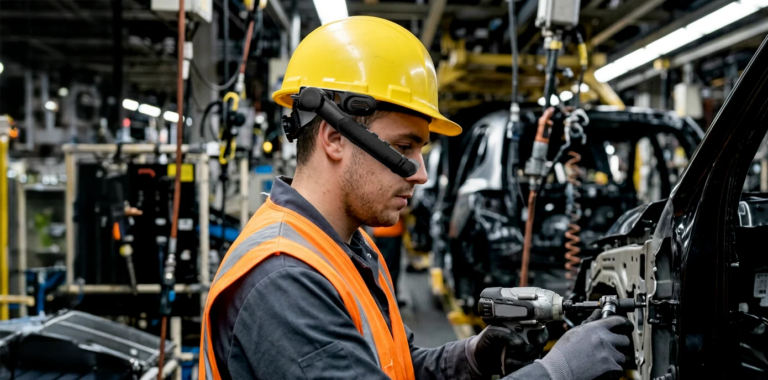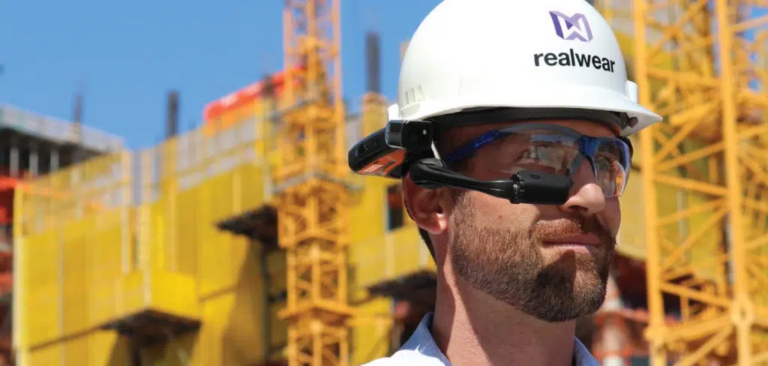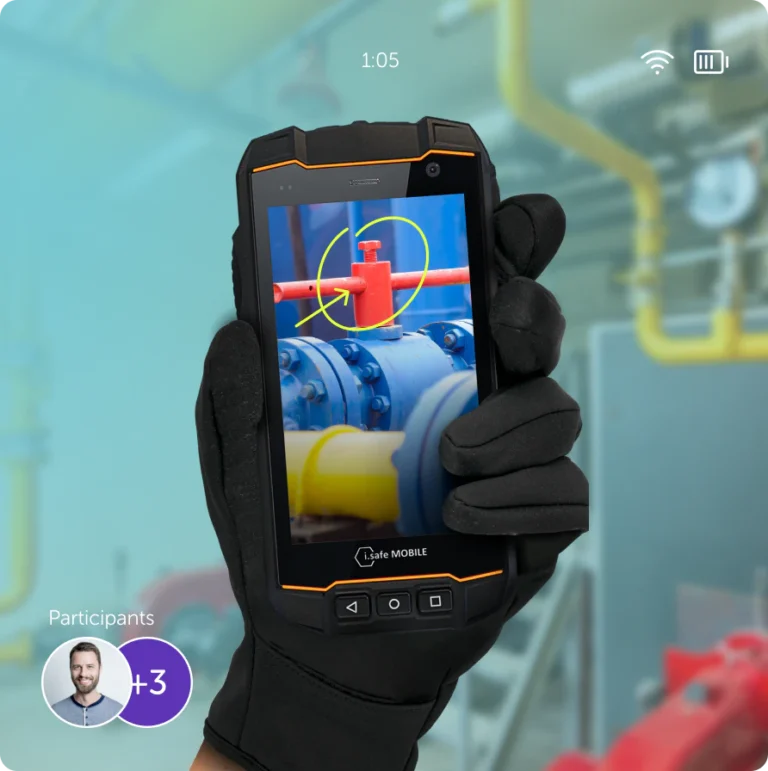







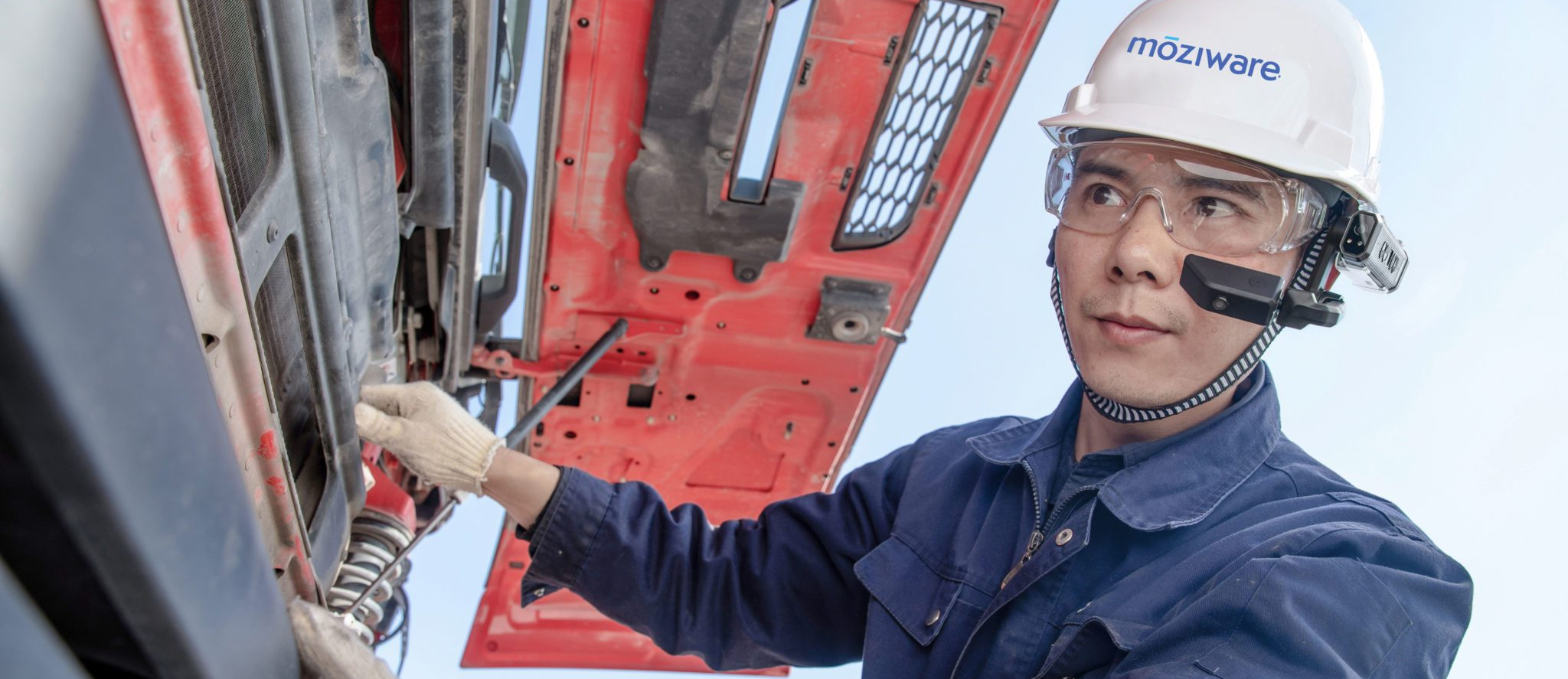
Moziware’s cımō headset is a 155 g, IP66-rated wearable computer built for hands-free data capture and remote collaboration on industrial sites, running Android 10+ Infinity OS on a Qualcomm Snapdragon 662 chipset (moziware.io). Paired with remote-assistance software such as Wideum’s Remote Eye and Process Eye, the eyewear lets a frontline technician receive live video support or follow a digitised work instruction without putting down tools. In 2026, this combination of a lightweight headset and purpose-built software is what separates a useful industrial deployment from an unused pair of glasses sitting in a drawer.
What Makes Moziware cımō Suitable for Industrial Workspaces in 2026?
Moziware cımō is built around a pocket-sized, foldable design that still meets industrial ruggedness standards. The headset weighs 155 g, is rated IP66 for dust and water resistance, and withstands drops onto concrete from 1,5 m at any angle; it also keeps working across an operating range of -20°C to +50°C. Under the hood it runs an 8-core Snapdragon 662 processor at 2.0GHz with an Adreno 610 GPU, 32 GB of internal storage and 3 GB of RAM, connecting over Bluetooth BLE 5.0 and Wi-Fi 802.11 a/b/g/n/ac (moziware.io). The headset is manufactured and developed by Realwear (Shanghai) Intelligent Technology Co., Ltd., which built the Infinity OS hands-free interface specifically for harsh or dangerous environments (moziware.io).
On the capture side, cımō pairs a 16 MP main camera with image stabilisation, laser spotlight and LED flash with an 8 MP front camera, recording video up to 1080p at 60 fps (moziware.io). A 20° field-of-view, 854×480 outdoor-visible display sits on a six-way adjustable boom arm compatible with safety helmets, bump caps and safety glasses, and four digital microphones with noise cancellation keep voice commands reliable in up to 90 dBA of industrial noise. The built-in 750 mAh battery supports up to 3 hours of normal use, extendable to 8 hours when tethered to an optional 5.000 mAh battery pack (moziware.io).
How Does Moziware Eyewear Compare to RealWear and Vuzix Headsets in 2026?
Moziware cımō is lighter and more compact than the RealWear Navigator 520, while the Vuzix M400 and RealWear devices offer higher display resolution and swappable batteries built for longer shifts. Each manufacturer targets a slightly different balance of weight, battery life and ruggedness, so the right pick depends on the job the eyewear needs to do.
| Spec | Moziware cımō | RealWear Navigator 520 | Vuzix M400 |
|---|---|---|---|
| Weight | 155 g (moziware.io) | 270 g (shop.realwear.com) | about 190 g with battery and frame |
| Chipset | Snapdragon 662, 8-core (moziware.io) | Snapdragon 662 (shop.realwear.com) | Qualcomm XR1, 8-core, 2,52GHz (vuzix.com) |
| RAM / Storage | 3 GB / 32 GB (moziware.io) | 4 GB / 64 GB (shop.realwear.com) | 6 GB / 64 GB (vuzix.com) |
| Display | 20° FOV, 854×480 (moziware.io) | 24° FOV, 1.280×720 HD (shop.realwear.com) | 16,8° FOV, OLED nHD (vuzix.com) |
| Battery | 750 mAh, up to 3h (8h with pack) (moziware.io) | 2.600 mAh, hot-swappable (shop.realwear.com) | Drop-safe to 2 m, IP67 (vuzix.com) |
| Ingress protection | IP66 (moziware.io) | IP66, MIL-STD-810H (shop.realwear.com) | IP67 on the Xtreme battery kit (vuzix.com) |
| Main camera | 16 MP, 1080p@60fps (moziware.io) | 50 MP, 1080p@60fps (shop.realwear.com) | 12.8 MP stills and up to 4K video at 30 fps (vuzix.com) |
Winner for pocket-sized, hands-free deployments: Moziware cımō, because its 155 g frame and foldable boom arm fit in a pocket between tasks, something neither the Navigator 520 nor the M400 kit is designed to do. Winner for all-day, high-resolution field work: RealWear Navigator 520, thanks to its hot-swappable 2.600 mAh battery and 50 MP camera. Winner for extreme weather exposure: Vuzix M400 with its optional IP67 Xtreme Weather battery pack (vuzix.com).
RealWear’s earlier HMT-1 model remains relevant for comparison: it weighs 380 g, carries a 3.250 mAh battery rated for a full 9 to 10-hour shift, and keeps the same IP66, MIL-STD-810G rugged rating with a 2-meter drop test (support.realwear.com). That extra weight versus cımō illustrates the trade-off between battery autonomy and wearable comfort that buyers face in 2026.
Why Pair Moziware Smart Glasses with Remote Assistance Software in 2026?
Moziware cımō headsets are designed to connect to enterprise systems and third-party apps, which is what makes them useful with dedicated remote-assistance software rather than as a standalone device. The headset supports more than 200 Android apps and IoT connections out of the box (moziware.io). Wideum’s Remote Eye software uses that connectivity to deliver immediate live video remote assistance, letting a remote expert see exactly what the on-site worker sees through the eyewear’s camera and guide them step by step (Wideum). Process Eye, Wideum’s companion product, turns the same hardware into a step-by-step workflow tool for quality assurance tasks (Wideum).
Beyond its three core products (Remote Eye, Process Eye and Picking Eye, the voice and camera-based picking software), Wideum offers five add-ons that extend what Moziware eyewear can do on an industrial floor: a Remote Helpdesk for WhatsApp-style professional support, a Remote Desktop that lets an expert take control of machine PCs, an AI Technical Assistant that answers questions from a company’s own manuals and reports, a Remote ATEX configuration built for intrinsically safe environments, and an Object Detection module that uses computer vision to detect, count and verify objects in real time (Wideum). Remote Eye and Process Eye run on smart glasses from Vuzix, RealWear and Moziware, as well as on rugged phones and tablets, which means a plant that already owns Moziware headsets does not need to replace hardware to add remote support capability.
Industrial Eyewear Trends to Watch in 2026
Smart glasses adoption kept accelerating through 2025, with shipments reaching 7,25 million units and representing roughly half of all XR hardware sold globally that year, up from 25% in 2024 (Treeview, 2026). Consumer-facing eyewear such as Ray-Ban Meta drove a large share of that volume, moving more than 6,5 million units on its own (Treeview, 2026), while the broader XR hardware and software market is projected to reach 85,56 billion $ by 2030 (Treeview, 2026). For industrial buyers, the practical takeaway is that the hardware ecosystem around rugged, enterprise-grade eyewear like Moziware’s cımō is maturing alongside the consumer segment, with more software vendors building integrations for voice control, remote video and workflow guidance.
Common Mistakes When Deploying Industrial Smart Glasses
Problem: choosing a headset by weight or price alone, without checking battery runtime against shift length. Solution: match the device to the task. A 155 g headset like Moziware cımō suits short, mobile inspection rounds, while a hot-swappable battery design such as the RealWear Navigator 520 better covers a full shift without a charging break (shop.realwear.com).
Problem: buying rugged eyewear and never connecting it to remote-assistance or workflow software. Solution: pair the hardware with a product such as Remote Eye or Process Eye from day one, since the headset’s camera and microphone array only create value once a remote expert or a digitised checklist is on the other end of the connection (Wideum).
Problem: deploying an IP66-rated device in an environment that requires a higher ingress rating or ATEX certification. Solution: check the manufacturer’s rating before purchase; Moziware cımō and RealWear’s Navigator 520 are both rated IP66 (moziware.io; shop.realwear.com), while Vuzix’s M400 reaches IP67 only with its optional Xtreme Weather battery kit (vuzix.com), and sites with explosive atmospheres should look at a Remote ATEX configuration instead (Wideum).
Key Takeaways
- Moziware cımō weighs 155 g, is IP66-rated, and withstands drops from 1,5 m, running Android 10 with Infinity OS on a Snapdragon 662 chipset (moziware.io).
- The built-in 750 mAh battery gives up to 3 hours of standalone use, extendable to 8 hours with an optional 5.000 mAh battery pack (moziware.io).
- The main camera captures 16 MP photos and video up to 1080p at 60 fps through a 20° field-of-view, 854×480 display (moziware.io).
- RealWear’s Navigator 520 (3.150,00 $ USD) and Vuzix’s M400 (1.499,99 $ USD) are heavier manufacturer-rated alternatives with hot-swappable or weather-rated batteries (shop.realwear.com; vuzix.com).
- Moziware headsets connect to Wideum’s Remote Eye and Process Eye software for live video support and step-by-step quality workflows, alongside add-ons like AI Technical Assistant and Object Detection (Wideum).
- Smart glasses shipments reached 7,25 million units in 2025, about half of all XR hardware sold that year (Treeview, 2026).
Updated: October 5, 2026
Frequently Asked Questions
What is Moziware cımō used for?
Moziware cımō is a pocket-sized, hands-free wearable computer used for industrial data capture, voice-controlled operation and remote video collaboration, letting a frontline worker share a live camera feed with a remote expert (moziware.io).
What is Moziware cımō used for in industrial workspaces in 2026?
In 2026, Moziware cımō is primarily deployed for live remote assistance through software such as Wideum’s Remote Eye, step-by-step quality workflows through Process Eye, and voice-based picking or inspection tasks on factory floors, warehouses and field-service sites (moziware.io; Wideum).
How much does the Moziware cımō headset weigh?
The Moziware cımō headset weighs 155 g, which the manufacturer presents as a lightweight, foldable design that fits in a pocket (moziware.io).
Is Moziware cımō waterproof and dustproof?
Yes. Moziware cımō carries an IP66 rating, meaning it is dust-tight and resistant to water, and it can be cleaned with alcohol wipes (moziware.io).
Can Moziware smart glasses connect to remote assistance software in 2026?
Yes. Moziware cımō headsets support more than 200 Android apps and third-party integrations, and in 2026 they can run Wideum’s Remote Eye for live video remote assistance and Process Eye for guided, step-by-step workflows (moziware.io; Wideum).
Sources
Moziware cımō User Manual
Moziware official site
RealWear Navigator 520 product page
RealWear HMT-1 specifications
Vuzix M400 smart glasses
Wideum – About Us
Wideum – Smart Glasses & Remote Support Guides
Treeview – Best Smart Glasses Companies (2026)